Gerber in Bogotá: How to Photograph Toddlers Who Will Not Take Direction
Bogotá, Colombia · February 14, 2024 · 2 min read
Two days in a Bogotá kitchen shooting a Gerber campaign with children too young to be directed — building a set they could wander around freely, then waiting for the frames to happen.
There is a rule on children's campaigns that everybody learns on their first one: you are not directing, you are fishing. The client has a shot list. The children have not read it. Somewhere between those two facts is a usable campaign, and the only way to reach it is to build a situation where the right thing is likely to happen, then be ready when it does.
Gerber brought me into a Bogotá house for two days with children too young to be given a single instruction. Here is what that actually looks like.
Light the whole room, not the subject
On a normal set you light where the subject will be. With toddlers there is no such place. So we lit the entire kitchen to a consistent, soft, warm level — big sources bounced wide, nothing hard, no marks on the floor — and accepted a stop less than we would have liked in exchange for total freedom of movement.
The pay-off is the crawling frame. She came down the length of the kitchen floor entirely on her own initiative and the exposure held the whole way. On a conventionally lit set that shot does not exist.
Let the mess in
Food brands for this age group used to be photographed spotless. That has thankfully changed, because any parent looking at a spotless picture knows immediately that it is a lie. The strongest frames here are the messy ones — cereal thrown in an arc across the floorboards, a child sitting in the middle of it perfectly content, a bowl abandoned within reach.
The scatter is doing real compositional work too. Those small coloured pieces lead the eye across an otherwise empty wooden foreground straight to the child. Mess, arranged slightly, is a leading line.
“You are not directing. You are building a situation where the right thing is likely to happen, then waiting.”
The adult is a supporting actor
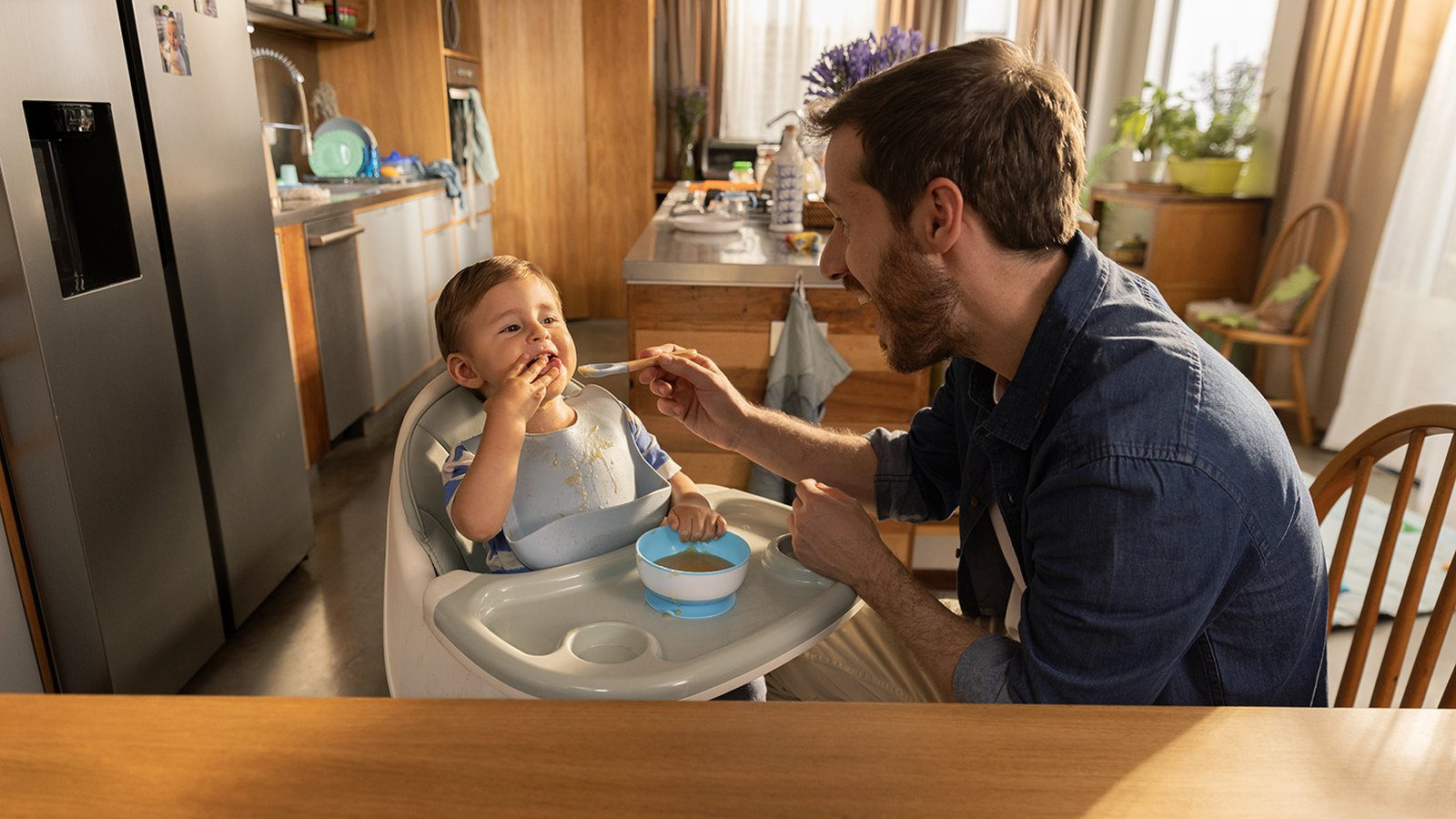
One frame includes the father, and only one. He comes in from the left with a spoon, in profile, slightly darker than the child — present, clearly the parent, definitely not the subject. Family campaigns lose their way when the adults start performing warmth at the camera. Give them a task instead: feed the child. Warmth arrives on its own.
It is the same principle behind the orange juice work in Florida — hand the talent something real to do and stop asking for an expression.
Shoot long, edit hard
Two days produced several thousand frames for a campaign that needed six. That ratio is normal and should be budgeted for rather than apologised about. Children work in bursts of about twenty usable minutes, and you get maybe four of those windows a day.
Everything else is preparation, patience and keeping the room warm enough that nobody minds you being there. The same waiting discipline runs through most of my commercial work in Bogotá, including the Bancolombia library shoot for Getty.